With the Summer Cottage, I wanted to capture the nostalgia of an unhurried summer sunset. That childhood holiday feeling, when the days seemed endless and there was still time to linger before going indoors. The whole painting, for me, was about a world away from digital distractions, and being completely absorbed in the glory of a closing afternoon in the countryside.
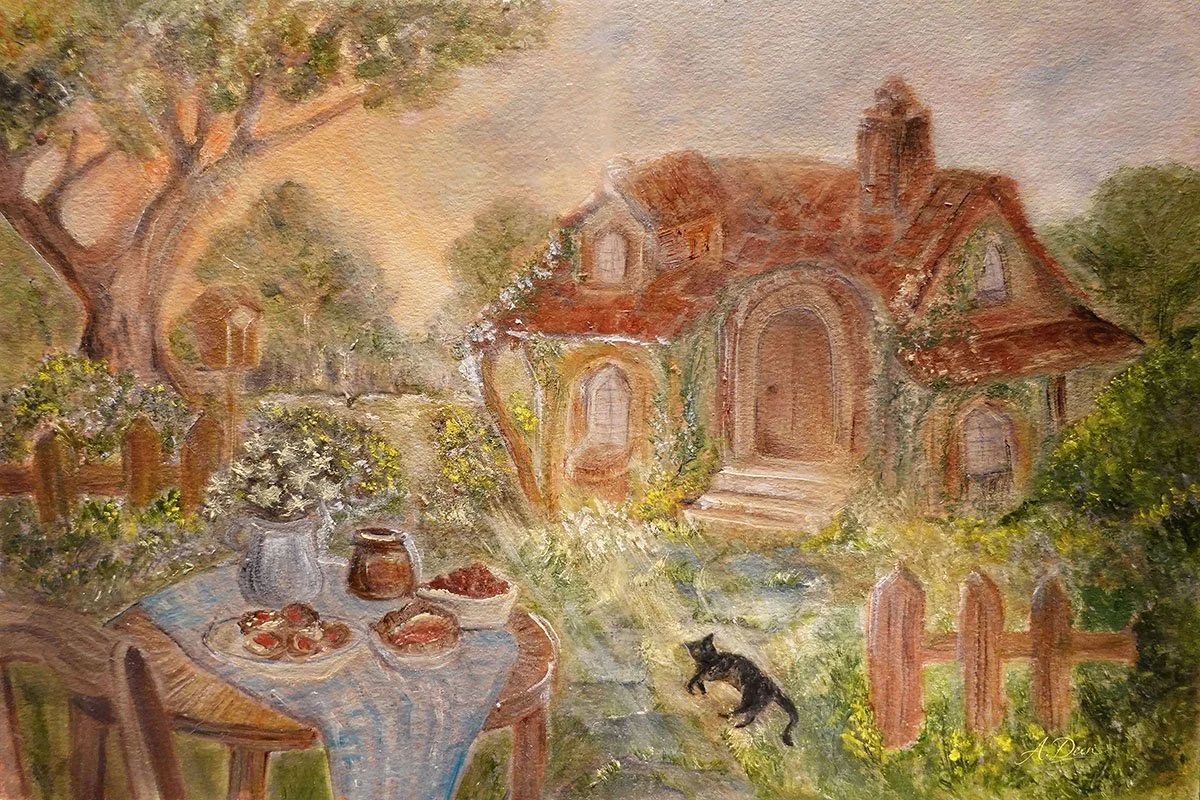
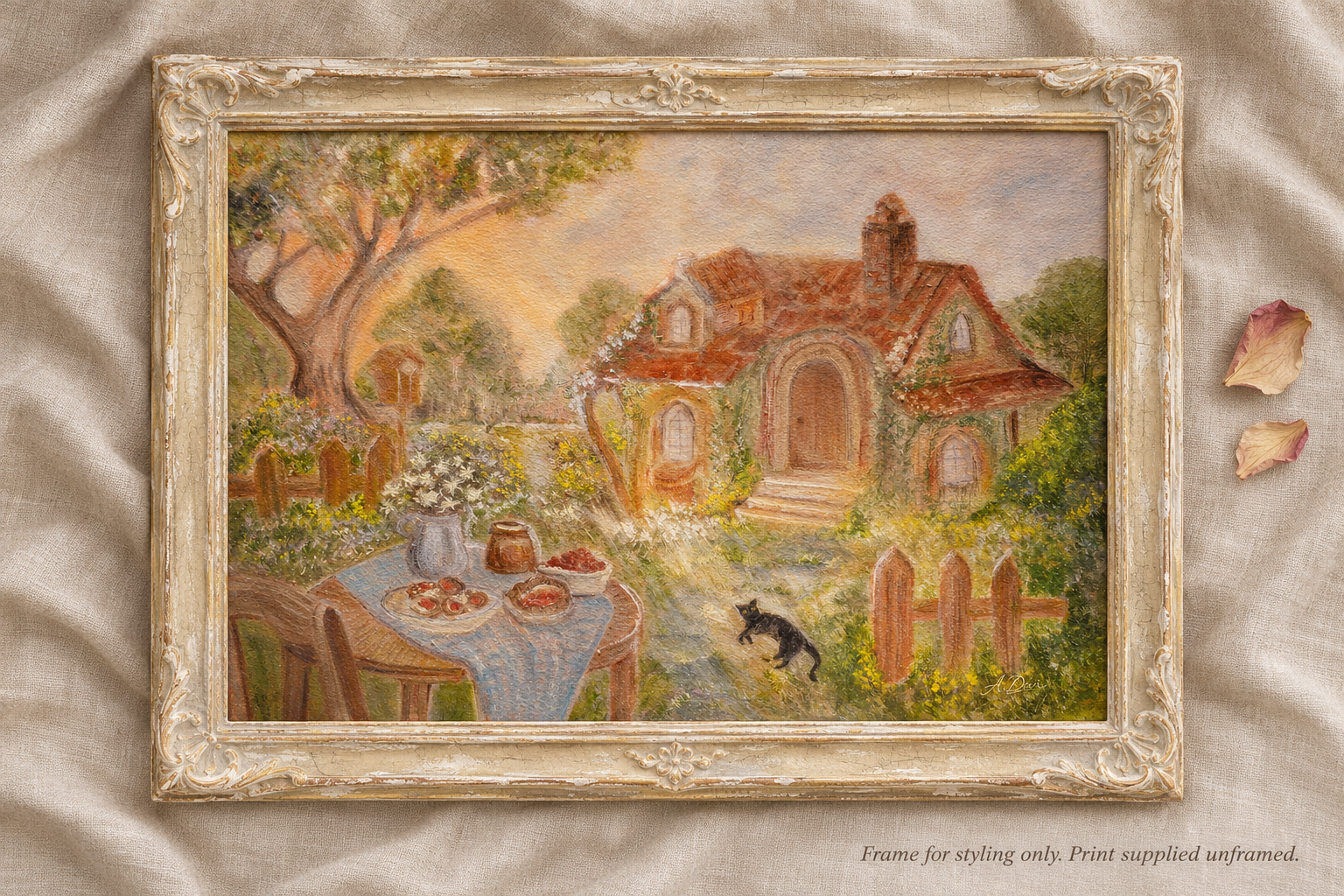
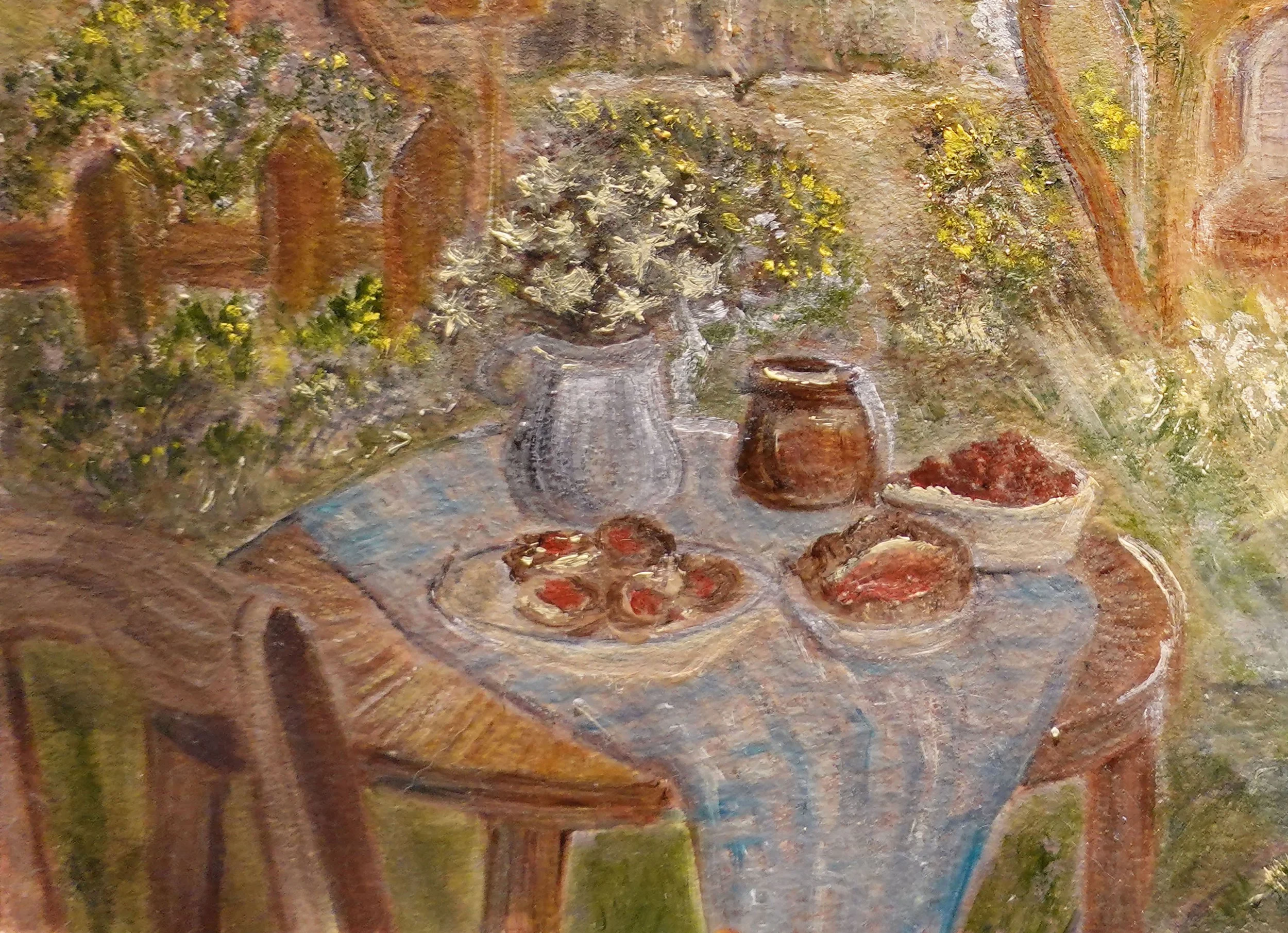

The cottage is part of that feeling, but so are the smaller things around it. There is tea on the table, a blue cloth falling over its edge, flowers beside the fence and a little black cat on the path. The scene leaves room to imagine what might happen next. Perhaps someone will come through the gate. Perhaps the tea will be poured. For the moment, the light is still there, and nothing in the picture asks us to hurry.
I think that is one of the things nostalgia can give us: a clearer sense of what we miss. It may be less about returning to a particular place than remembering a quality of attention. A childhood holiday can feel spacious in memory because the smallest things have room to become interesting. The shape of a tree, the changing colour of a wall, something moving in the grass. An afternoon can hold a whole little world.
That is the feeling I wanted this painting to offer. The cottage belongs to an imagined countryside, rather than a named place you have to recognise. Its rounded doorway and warm roof give it something of a storybook character. You can decide who lives there and whether the chair at the table might be yours. There is a welcome in leaving some of the story unfinished.
The light is what holds the scene together. It settles across the garden and gives the roof and fence their warmth. Summer is often pictured through bright skies and busy days, but I wanted the quieter end of the afternoon: that softened hour when the day is closing and there is still enough light to enjoy where you are. The pleasure is in noticing it while it lasts.
For a literary companion, W. H. Davies’s poem Leisure offers a natural connection. Its question about making time to notice the world feels close to the invitation in this garden. Read alongside the painting, it opens another way of spending time with the scene. [2]
There is a ballet connection, too, in Frederick Ashton’s The Dream, a ballet drawn from Shakespeare’s A Midsummer Night’s Dream and set to Mendelssohn’s music. Its enchanted world offers a companion to the painting’s storybook atmosphere. The connection here is imaginative: the sense that an ordinary landscape might contain another world if we stay with it long enough. It is an association to explore, rather than a scene the cottage is meant to illustrate. [1]
Bringing those connections together does not need to turn an afternoon into a project. You could read a little of the poem, listen to some music or simply look at the painting. There is no need to complete all three. What interests me is the possibility of allowing one small pleasure to lead gently to another, without making it another task to finish.
That is also where the painting meets wellbeing. There may be parts of a childhood summer we cannot recreate, but we can still make space for attention. We might leave a phone in another room while we drink our tea, sit beside an open window or notice the last light reaching a familiar corner. These are modest things. Their value is in the experience itself, rather than in what we can measure afterwards.
If I use the word manifestation here, I mean giving an intention a shape we can return to. A picture can remind us of something we would like to welcome into our days: more space, a little beauty, time to enjoy an interest. It cannot guarantee a different life. It can, however, help us remember the kind of moment we want to make room for, and prompt a small choice in that direction.
The time-lapse painting film offers another way into this scene. Although it is watched on a screen, the invitation is to settle with one quiet creative experience. You can watch the painting take shape without needing to learn a technique or make anything yourself. Enjoying someone else’s process can be enough. Afterwards, perhaps the best next step is to close the screen and notice something near you.
For anyone who would like to keep the image nearby, A Quiet Summer Afternoon is offered as an open-edition fine art print. But you are just as welcome to spend time with the film and leave with the feeling of the garden. I hope the cottage, the waiting tea and that little cat offer a place for your attention to rest. The afternoon is closing, and there is still a little time to enjoy it.
A Cozy Summer Cottage Escape 🌿 Relaxing Oil Painting Timelapse | No Talking - YouTube
Article references
[1] Frederick Ashton Foundation, The Dream (1964): https://frederickashton.org.uk/ballet/the-dream-1964/ — source for choreographer, Shakespeare connection and Mendelssohn music. The article’s association with this painting is an editorial suggestion, not a claimed original influence.
[2] W. H. Davies, Leisure, text: https://www.poetry.com/poem/40653/leisure — thematic companion only; no poem lines reproduced. Archive context: https://archives.library.wales/index.php/informationobject/browse?collection=3186971&topLod=0
Watch the time-lapse painting film: A Cozy Summer Cottage Escape 🌿 Relaxing Oil Painting Timelapse | No Talking
Explore the print: Summer Cottage — Anaya Wellbeing
Take-away
What is one small detail you remember from a summer holiday? Write about its light, colour or sound, without needing to tell the whole story. Then choose one unhurried moment you could make room for this week.